
Flying is one of the hardest sectors to decarbonise, but the European Union is taking another step towards cleaner aviation. The European Commission has approved two Dutch state aid schemes, sharing a combined budget of €290 million, to support the production of sustainable aviation fuel (SAF).
One scheme funds SAF production directly. The other funds the early planning and engineering work that projects must complete before construction can begin. Together, the supported projects are expected to produce around 285,000 tonnes of SAF each year, enough to replace roughly 350 million litres of conventional jet fuel, equivalent to powering around 3,500 long-haul flights annually.
What SAF is, and why it helps
Unlike traditional jet fuel made from fossil oil, SAF can be produced from sustainable biomass such as used cooking oil and agricultural waste, or by combining renewable electricity with captured carbon dioxide to create synthetic fuels known as e-SAF. Depending on how it is produced, SAF can reduce lifecycle greenhouse gas emissions by up to around 80% compared with conventional jet fuel, while working with today's aircraft and airport infrastructure without modification.
Why this funding, and why now
SAF is currently expensive, typically costing two to five times more than conventional jet fuel. Much of that premium reflects the fact that production remains at an early commercial stage, with relatively few facilities operating compared with the global market for conventional aviation fuel. By supporting early commercial projects, the funding aims to expand production, improve economies of scale and help reduce costs over time.
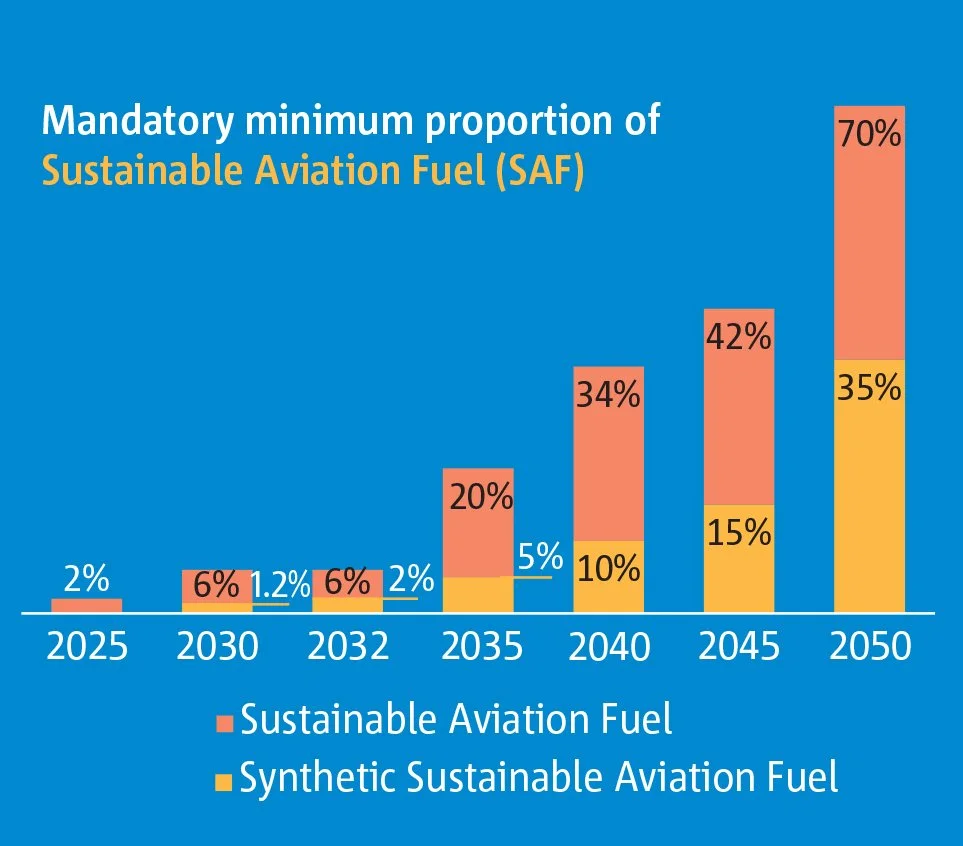
There is also a legal driver behind the push. Under the EU's ReFuelEU Aviation Regulation, airlines are already required to blend a minimum share of SAF into the fuel supplied at EU airports, starting at 6% by 2030 and rising to 70% by 2050, with a smaller, separate requirement for synthetic e-SAF. Meeting those targets depends on enough SAF being produced, which is why direct government support for early production capacity matters now.
The funding forms part of the EU's wider Clean Industrial Deal strategy to build a cleaner aviation sector, alongside longer-term work on technologies such as hydrogen and electric aircraft that remain further from commercial use.
SAF Policy Actions - ReFuelEU Aviation