
Europe’s Rooftops Could Supply 40% of Power
Rooftop solar panels could end up supplying around 40% of the European Union’s electricity needs by 2050, according to a new EU-wide scientific analysis that highlights the enormous untapped potential sitting on top of homes, offices and commercial buildings.
Researchers estimate that the rooftops of the EU’s 271 million buildings could host about 2.3 terawatts (TW) of solar capacity, generating roughly 2,750 terawatt-hours (TWh) of electricity per year using today’s technology. That output would be enough to meet around two-fifths of electricity demand in a fully renewable European energy system.
The study, published in Nature Energy, is the first to map rooftop solar potential building by building across the entire EU, using a high-resolution digital model of Europe’s building stock combined with national data. It also reflects improvements in solar panel performance, with average efficiency rising from around 18% in 2018 to about 22% today.
Residential buildings account for the largest share of potential, with around 1.8 TW of capacity, while non-residential buildings such as warehouses, offices and shopping centres could host a further 500 gigawatts. Large commercial rooftops are seen as particularly important because they can carry dense arrays of panels and connect easily to the grid.
The findings suggest rooftop solar could play a major role in meeting near-term targets as well. By 2030, more than half of the EU’s current solar capacity goal could be delivered by non-residential rooftops alone, the researchers say. Despite this potential, rooftop solar remains vastly underused. Only about 10% of European rooftops currently have solar panels, even though rooftop systems already make up around 60% of the EU’s installed solar capacity.
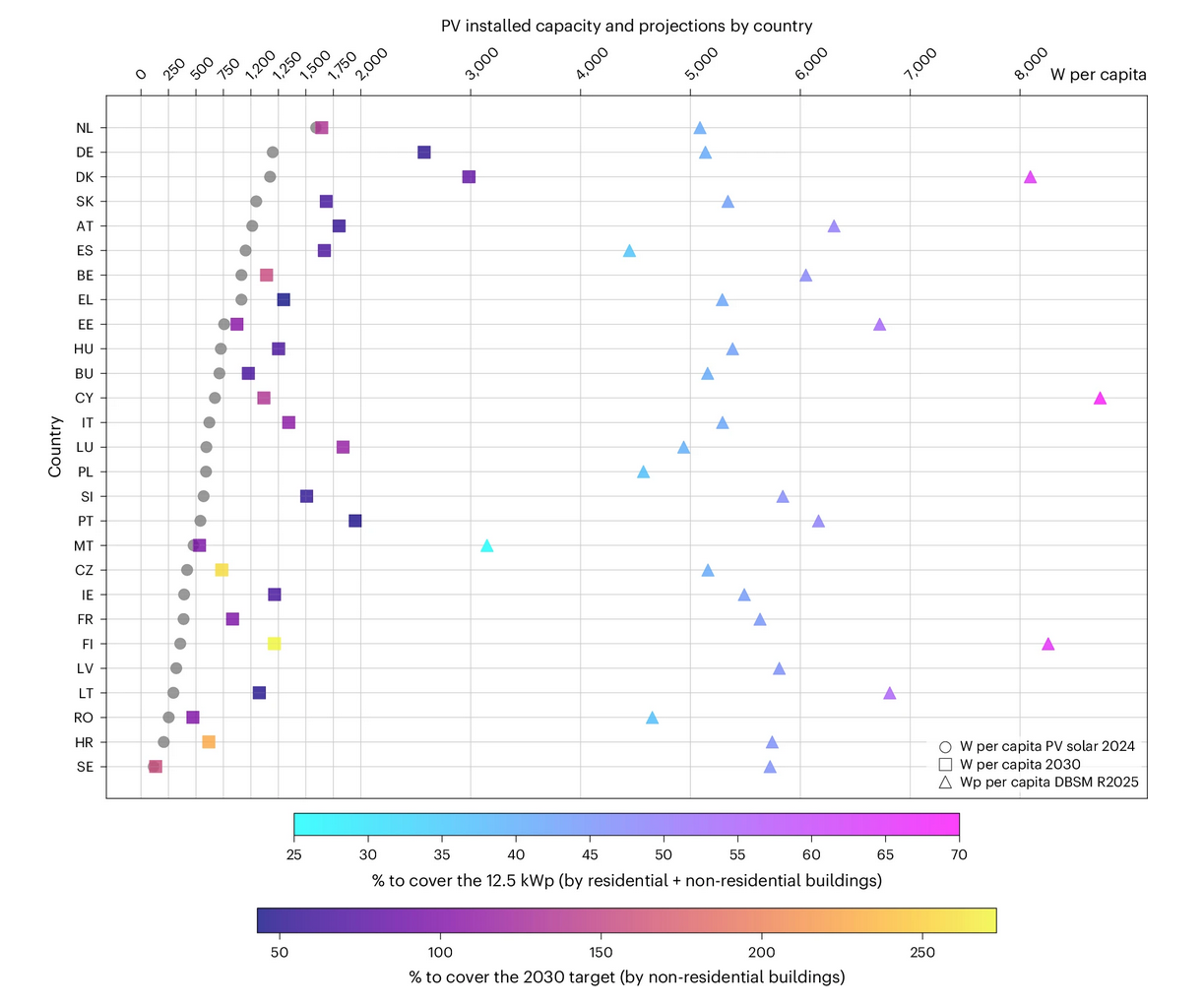
Buildings are a central part of Europe’s climate challenge, responsible for roughly 42% of energy consumption and 36% of energy-related emissions. Expanding rooftop solar could help cut those emissions while supporting the wider electrification of heating and transport, including heat pumps and electric vehicle charging.
The researchers argue that combining rooftop solar installations with building renovations offers one of the fastest and most practical routes to scaling clean electricity generation, lowering energy bills and strengthening energy security across the bloc.