
Trump Targets Data Centres to Fund New U.S. Power Capacity
The Trump administration is preparing to unveil a major intervention in the U.S. electricity market aimed at preventing rising power costs from being passed on to households as energy demand from data centres surges.
Under the proposal, PJM Interconnection — the nation’s largest grid operator, covering much of the Northeast and Midwest — would be pushed to run a special emergency auction for new power generation. Large technology companies building power-hungry data centres would bid for long-term, 15-year electricity contracts, effectively funding the construction of new power plants needed to meet their rapidly growing demand.
The core argument behind the plan is straightforward: companies driving a sharp increase in electricity use should cover the cost of supplying it. President Trump has repeatedly said that “big technology companies who build data centres must pay their own way,” rather than shifting costs onto households and small businesses through higher utility bills.
Electricity prices in the U.S. have risen by around 6–7% over the past year. While new power plants can take years to build, demand from data centres and artificial intelligence workloads is accelerating much faster. The administration argues that securing long-term payments upfront from well-capitalised tech firms would give power producers the revenue certainty needed to invest in new capacity sooner, helping ease future price pressures.
According to reporting from the White House, the proposed auction would require winning bidders to pay for electricity across the full life of the contract — whether the power is ultimately used or not. That structure would inject capital directly into generation projects, allowing new plants to be built to serve data-centre demand without immediately feeding higher costs into consumer electricity bills.
The urgency behind the move is reinforced by demand forecasts. The U.S. Energy Information Administration expects electricity consumption to reach record highs in 2026, marking the strongest multi-year growth in decades. Large data centres are cited as a key driver, alongside electrification and industrial demand. Academic and industry studies suggest data-centre electricity use — including AI and crypto-related activity — could more than double by the end of the decade if current trends continue.
One study cited by the administration warns that, without intervention, growth in data-centre demand could push average household electricity bills up by as much as 25% over the next four years. The White House has framed the proposed auction as a way to support U.S. leadership in artificial intelligence while shielding consumers from those cost impacts.
Other policy routes were available. Lawmakers could have allowed utilities to recover the cost of new generation and grid upgrades through traditional rate increases, reformed PJM’s existing capacity market rules, or required large new users to secure power through direct contracts or on-site generation. Options such as higher connection charges, demand-flexibility requirements, or public investment in new capacity were also possible. The administration’s approach stands out by explicitly assigning the cost of new power plants to the companies driving demand growth, rather than spreading it across all electricity users.
The challenge is not unique to the United States. International Energy Agency base-case projections for 2020 to 2030 show data-centre electricity consumption rising across all major regions, including North America, Europe and Asia, as cloud computing, AI and digital services expand. While North America and Asia are expected to see the strongest growth, the trend is global, forcing governments and grid operators everywhere to confront the same trade-off: how to support digital and economic growth while keeping electricity affordable and systems reliable.
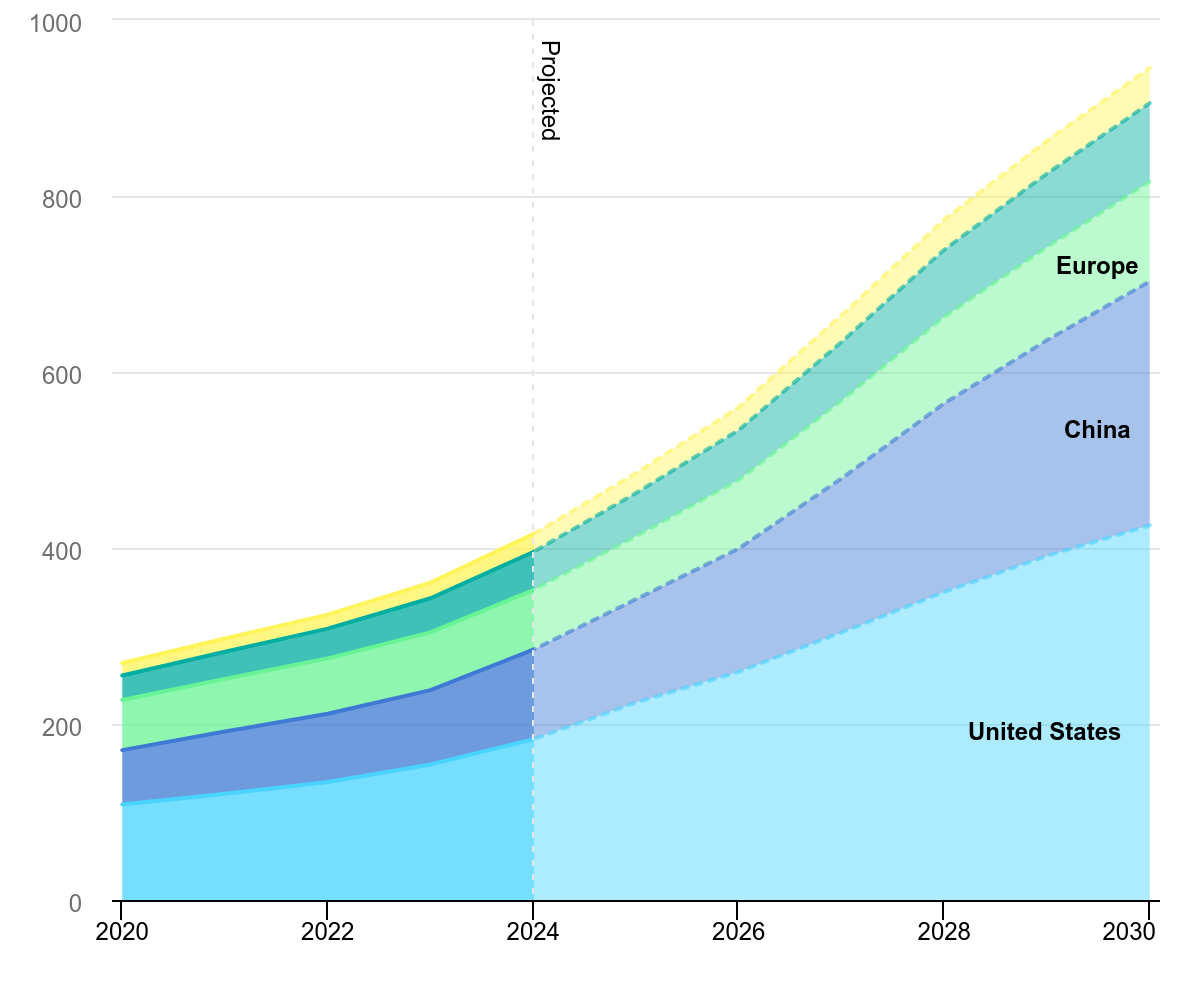
IEA (2025), Data centre electricity consumption by region, Base Case, 2020-2030, IEA, Paris
Supporters of the U.S. proposal argue it reflects the scale and urgency of the challenge facing power systems as AI reshapes energy demand. Critics are likely to question the complexity of emergency auctions, the risk of locking in long-term prices in a fast-changing energy landscape, and whether such interventions could distort electricity markets or deter investment in some regions.
An official announcement is expected imminently. If implemented, the plan would mark one of the most direct attempts yet to link the explosive growth of data centres to the financing of new U.S. power generation — potentially setting a precedent for how other regions manage the energy costs of the AI boom.