
UK New Car Market Hits Two Million as EV Growth Faces Headwinds
The UK new car market returned to growth in 2025, with registrations reaching 2.02 million, up 3.5% year on year, marking the strongest annual total so far this decade. Electric vehicles continued to gain traction, with almost half a million battery-electric cars sold and around one in four buyers choosing to go fully electric. Even so, petrol and diesel models still made up just over half of new registrations, highlighting the distance between rising EV interest and the government’s longer-term targets.
The recovery in electric car sales was supported by the return of the Electric Car Grant, which lowered upfront costs for some buyers. However, the impact has been limited by the fact that only around a quarter of EV models currently qualify for the incentive. In practice, manufacturers have continued to drive most of the demand themselves, subsidising sales by more than £5 billion over the year — equivalent to roughly £11,000 per electric car sold. Industry leaders warn this level of support cannot be sustained indefinitely.
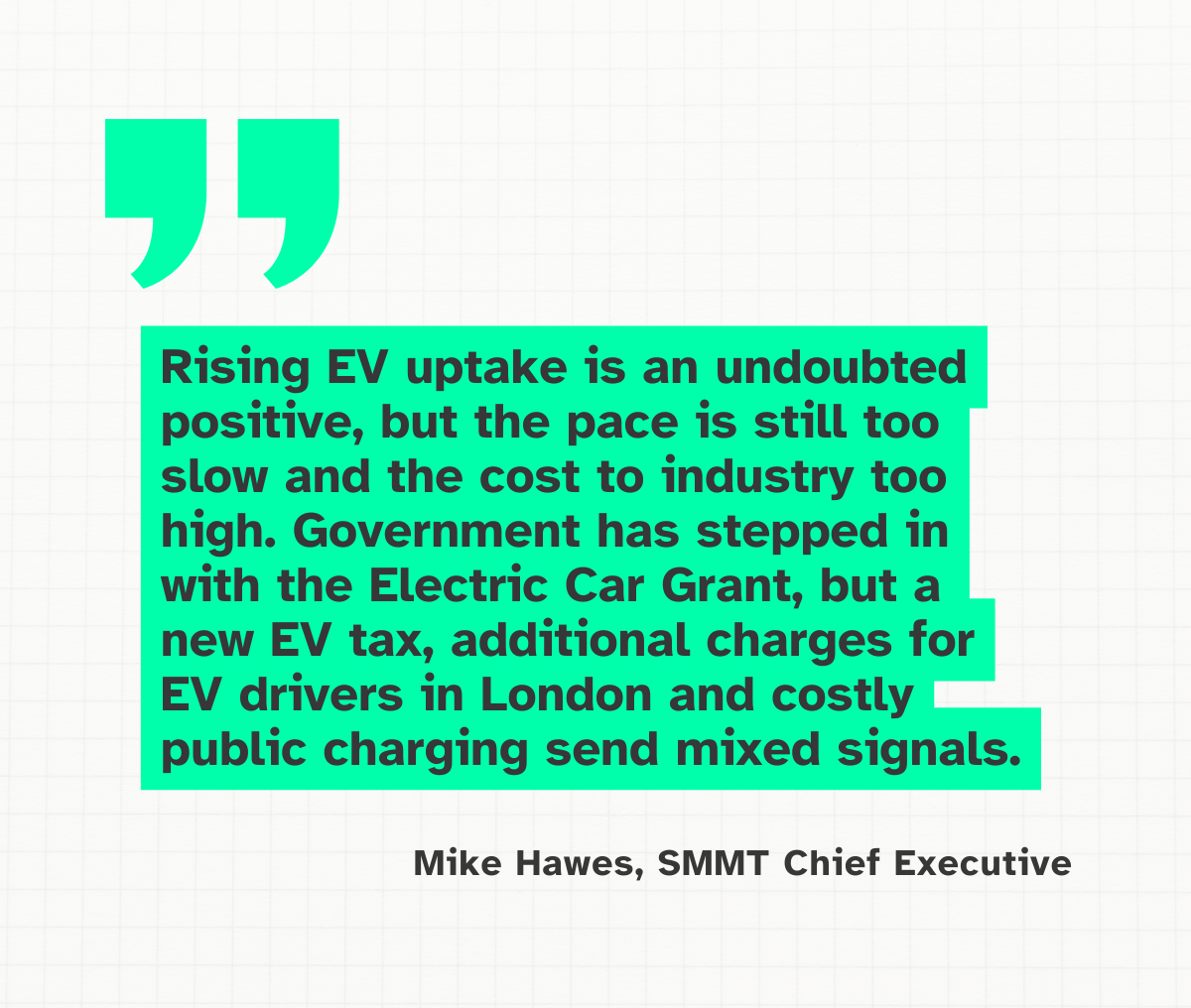
At the same time, future tax changes are adding uncertainty. The planned introduction of a new ‘eVED’ tax on electric vehicles from 2028, along with congestion and charging costs in major cities, has raised concerns that buyers are receiving mixed signals just as the transition to electric vehicles is gathering pace.
The industry is now looking to the government’s upcoming review of the Zero Emission Vehicle (ZEV) Mandate, which sets binding targets for the share of zero-emission cars sold each year. Carmakers argue that adjusting the framework to reflect real-world demand will be essential to protect investment and keep the UK competitive.
That debate is increasingly shaped by developments elsewhere in Europe. While the UK has maintained a firm path towards ending sales of new petrol and diesel cars by 2035, the European Union has begun to soften its own timeline, allowing more flexibility for manufacturers and leaving room for some non-zero-emission vehicles beyond that date. The shift reflects concern over industrial competitiveness, EV affordability, and uneven consumer demand across the continent.
For the UK, the contrast is significant. A clear and stable policy framework has helped attract EV investment in recent years, but rising costs, changing taxes and policy uncertainty risk undermining that advantage. The challenge for policymakers in 2026 will be to balance ambition with realism — supporting faster electrification without pushing consumers or manufacturers away.